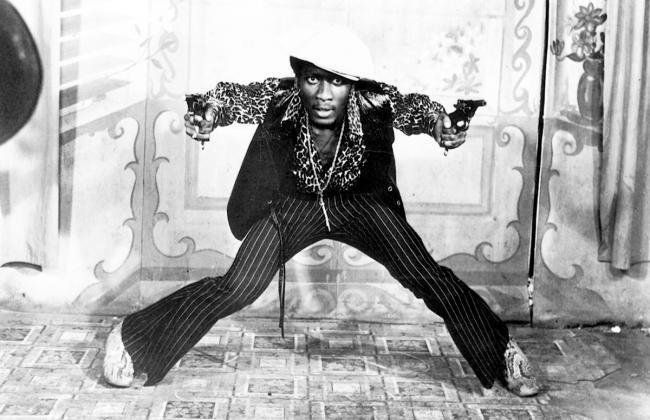
The subsequent role of the film in the popularisation of reggae has detracted from the fact that it’s actually an entertaining crime thriller whose appeal owed much to its social authenticity, notably the use of patois, which gave the film the sense of a national conversation about poverty and opportunity a decade after the early optimism of independence in 1962. The wider context was a country moving sharply left in the year of the film’s release with the election of the PNP under Michael Manley.
The plot is conventional. The title nods to Bogart’s last film role (the 1956 boxing noir, The Harder They Fall) but it also warns us that Jimmy Cliff’s protagonist, Ivan, will surely come to a sorry end. The bad guys – corrupt police officers, exploitative record producers, hypocritical preachers – are predictable, but the verve and pace of the film keeps us engaged and Cliff is always believable as the country boy gone bad in the city due to his own naivety as much as circumstance.
It’s also a film about media, fame and revenge, not just in the eventual success of Ivan’s records on the radio when he becomes notorious, but in the template of rough justice offered by spaghetti westerns (Ivan watches 1966’s Django), which would become a theme of reggae music in the 1970s.
The film proved difficult to distribute, despite praise at the Venice Film Festival, though the claim that this was due to the need for subtitles in the US was exaggerated. It found its home on the late-night circuit, such as the Scala Cinema in London, where the smell of ganja was not unknown, becoming a cult classic that provided both a background sound to, and a gallery of visual inspiration for, the crossover between reggae, punk and ska in British subculture in the late-70s and early-80s.
“Back in those days there were few of us African descendants who came through the cracks to get any kind of recognition. It was easier in music than movies. But when you start to see your face and name on the side of the buses in London that was like: wow, what’s going on? Reggae music was still considered a novelty. Once the music had a chance to be recognised, it just jumped out at people. And then [the film] showed people where the music was coming from.” Jimmy Cliff, 2022
This is a Black History Month screening