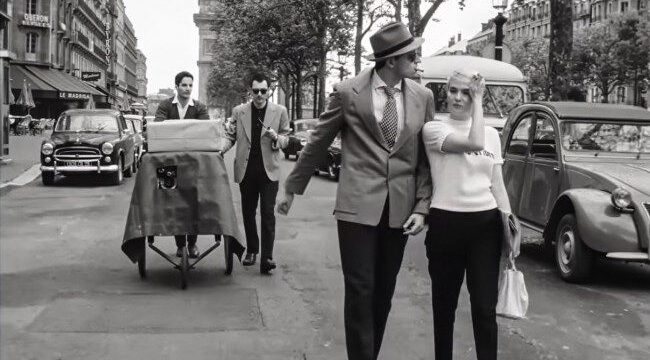
Richard Linklater has become famous for his elapsed time cinema, notably in 2014’s Boyhood, which was shot over 12 years, and the Before trilogy, which spread leisurely over 18 years. In Nouvelle Vague his interest in time is more subtle, concerning both the compression of the filmmaking process in Jean Luc Godard’s creation of 1960’s Breathless, and in the time travel that his homage engages in. The film is punctuated by intertitles and tableaux introducing famous characters, which creates an ironic effect. Is this a documentary or a drama? A question that could have been asked of Breathless itself.
Godard, played by Guillaume Marbeck, is presented as impatient, mercurial and sardonic. He badgers his way into the role of director and then proceeds to ignore convention, writing his screenplay on set, frustrating his actors and production crew with delays, ignoring continuity and straining the patience of his backers. He demands spontaneity from his actors, Jean Seberg (played by Zoey Deutch) and Jean-Paul Belmondo (played by Aubry Dullin), but is also dismissive of their opinions.
Godard comes across as an arrogant prig, but also as a cinematic visionary deserving of his subsequent reputation. Breathless really was a remarkable departure and hugely influential. Linklater is more of a craftsman as a director, as can be seen in the loving details of this film, whose experiments with form are more likely to command the support of the cast and crew, even when he asks for a commitment over years (Breathless was shot in only 23 days), but he recognises that what made Godard so significant was his willingness to take risks. That sense of vitality and danger is fully realised in this clever and funny film.
“Richard Linklater’s Nouvelle Vague is a beautiful, admiring portrait of a turning point in cinema.” Wendy Ide, The Observer
“Richard Linklater’s love letter to an iconic era of French cinema, this portrayal of the creation of Breathless, Jean-Luc Godard’s first feature film, celebrates Frenchness at its most proudly awkward.” Donald Clarke, Irish Times